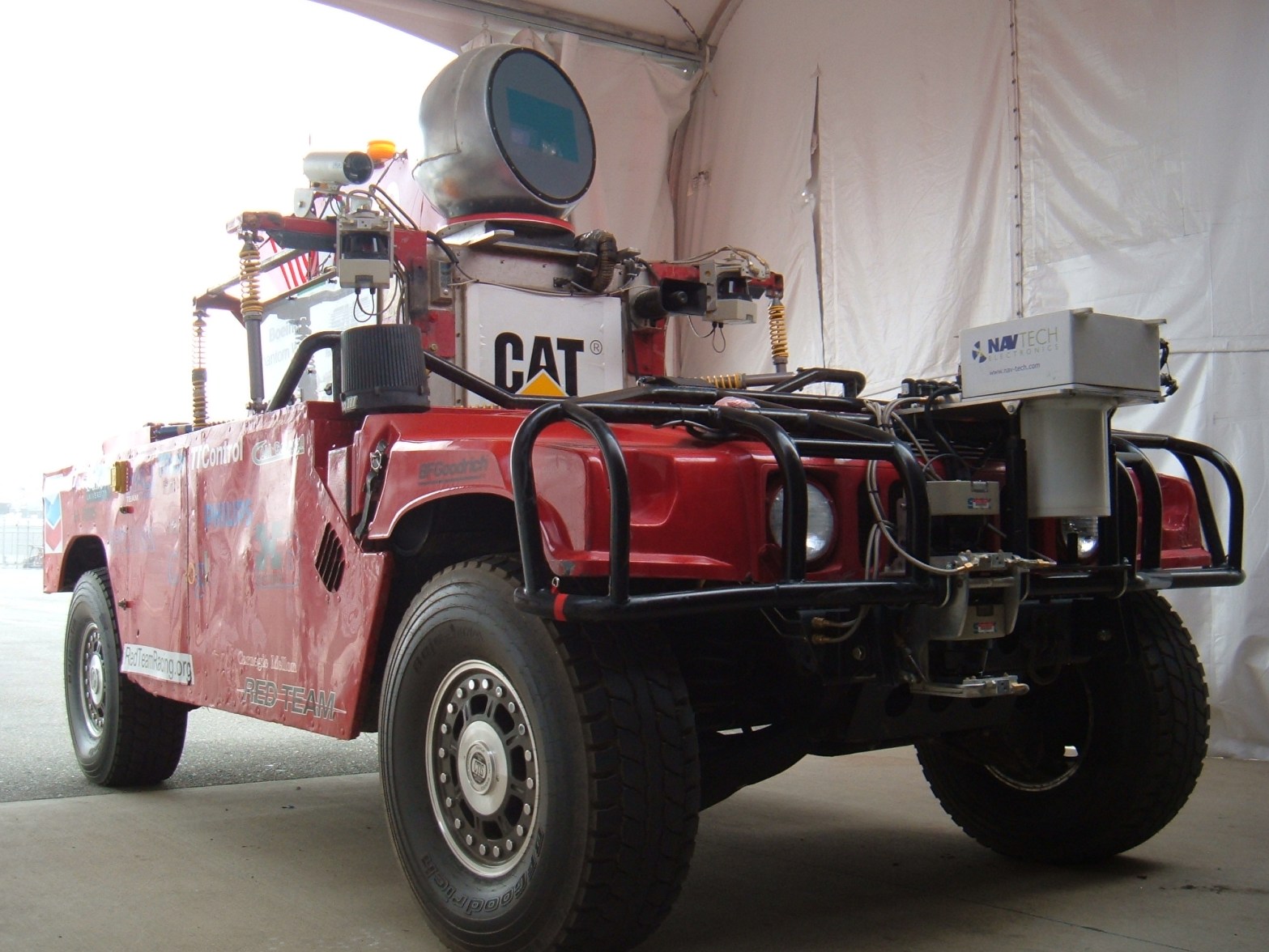
Autonomous navigation is the ability of a robot or vehicle to move through an environment safely and purposefully without continuous human control. In practice, that means much more than following a path. A useful autonomous system has to understand where it is, what surrounds it, where it should go, and how to move there safely.
The Core Pipeline
Although implementations differ, most navigation systems can be understood through a few major blocks:
- Perception: sensing the environment using cameras, LiDAR, radar, ultrasound, GPS, IMU, or wheel encoders.
- Localization: estimating the current position and orientation of the robot.
- Mapping: building or using a representation of the world.
- Planning: deciding where to go and how to get there.
- Control: generating steering, throttle, brake, or wheel commands to follow a trajectory.
Perception
No navigation system can work well without useful sensor input. Cameras provide rich visual information, LiDAR provides accurate geometric structure, radar performs well in difficult weather, and IMU sensors help with short-term motion tracking. In many real systems, sensor fusion is essential because each sensor has strengths and weaknesses.
Localization
A robot must know where it is before it can move intelligently. Localization may rely on GPS outdoors, but in indoor or high-precision environments it often depends on SLAM, particle filters, Kalman filters, or map-based matching. Even a strong planner becomes useless if the position estimate drifts too far from reality.
Mapping
Some robots navigate in a prebuilt map, while others build a map online. Common map types include occupancy grids, feature maps, lane maps, topological graphs, and semantic maps. The right representation depends on the environment and task. A warehouse robot does not need the same map structure as a self-driving car in urban traffic.
Planning
Planning can be divided into layers:
- Global planning: choose a route from start to destination.
- Behavior planning: decide actions such as stopping, yielding, or changing lanes.
- Local planning: generate a feasible short-horizon trajectory around obstacles.
Algorithms may include A*, Dijkstra, RRT, lattice planners, optimization-based methods, or behavior rules depending on the system.
Control
Once a trajectory exists, the controller turns it into actual motion. Common controllers include PID, pure pursuit, Stanley, LQR, and MPC. The choice depends on dynamics, accuracy requirements, and computational constraints.
A Real Example
Consider an autonomous delivery robot in a campus environment:
- It uses GNSS and IMU outdoors, plus LiDAR for obstacle detection.
- It localizes against a map of pathways and building entrances.
- It plans a global route to the target building.
- It adjusts locally to avoid pedestrians and parked bicycles.
- Its controller tracks the resulting path while keeping speed smooth and safe.
Why Autonomous Navigation Is Hard
- Sensor noise and drift are unavoidable.
- The world changes: people move, objects appear, weather varies.
- Planning must balance safety, comfort, efficiency, and real-time constraints.
- The full system only works if the modules interact reliably.
Final Thoughts
Autonomous navigation is not a single algorithm. It is a system problem that combines sensing, estimation, decision-making, and control. Understanding the interfaces between those layers is what turns theory into a working robot or vehicle.

 ACE IT SKILLS
Em chào anh Thành. Bài viết của anh rất hay và bổ ích cho những người mới tìm hiểu về Autonomous Navigation. Em đang tự học và nghiên cứu về xe tự hành. Anh có thể cho em địa chỉ mail để em có thể trao đổi với anh một số thắc mắc không ạ. Em cảm ơn anh.
LikeLike
Hi Hiep, neu co cau hoi gi em cu viet len day em^^, block nay anh lap ra dau co ai ngoai em dau:))
LikeLike
Có cả em nữa anh ơi :v
LikeLike