Posted in Robotics

Sơ lược(Sumary) Robot Operating System(ROS)

Vì thấy các bạn từ Việt Nam có sự quan tâm đến phần này nên hôm nay mình sẽ update nội dung tiếp về Robot operating system nhé, cảm ơn đã ủng hộ mình.

Robot operating system is a dedicated software system for programming and controlling robots, including tools for programming, visualizing, directly interacting with hardware, and connecting robot communities around the world. In general, if you want to program and control a robot, using ROS software will make the execution much faster and less painful. And you don’t need to sit and rewrite things that others have already done, but there are things that you want to rewrite are not capable. Like Lidar or Radar driver.

ROS runs on Ubuntu, so to use ROS first you must install Linux. For who do not know how to install Linux and ros, I have this link for you:

Robot operating system  là một hệ thống phần mềm chuyên dụng để lập trình và điều khiển robot, bao gồm các công cụ để lập trình, hiển thị, tương tác trực tiếp với phần cứng, và kết nối cộng đồng robot trên toàn thế giới. Nói chung là nếu bạn muốn lập trình và điều khiển một con robot, sử dụng phần mềm ROS sẽ giúp quá trình thực hiện nhanh hơn và bớt đau khổ hơn rất nhiều. Và bạn không cần ngồi viết lại những thứ mà người khác đã làm rồi, mà có những thứ muốn viết lại cũng không có khả năng. Như Lidar hoặc Radar driver chẳng hạn.

ROS chạy trên nền Ubuntu,  do đó để sử dụng ROS đầu tiền các bạn phải cài Linux. Cho bạn nào chưa biết cài Linux và ros thì mình có link này cho các bạn:

http://wiki.ros.org/kinetic/Installation/Ubuntu

Dưới đây mình sẽ trình bày về luận văn thạc sĩ của mình, phần dưới là 1 phần trích đoạn phần đầu của luận văn. Nếu bạn nào cần full không che thì pm mình bên dưới phần comment nhé:))

1.1 Đề xuất dự án – Robot tự hành di động

Hệ thống robot được sử dụng trong dự án này đã được phát triển trong quá trình nhiều trước các dự án tổng thể và chuyên môn hóa. Mục tiêu dài hạn của các dự án này là phát triển Các khái niệm robot tự động di động để hỗ trợ mọi người trong môi trường trong nhà, như đổ nước và phục vụ cho con người. Đề tài của luận văn này dựa trên đề tài do GS.TS. Nauth tại Bộ phận Công nghệ Thông tin, nơi gợi ý một số ứng dụng khả thi cho một robot như vậy:

• Robot có thể điều hướng tự động trong môi trường trong nhà, như phòng hoặc hành lang.

• Robot phải tránh chướng ngại vật khi di chuyển từ vị trí A đến B, chướng ngại vật ở đây bao gồm các chướng ngại vật tĩnh và động.

• Robot phải phân loại đối tượng, chẳng hạn như nhận dạng cốc và chai, sau khi robot đó có thể rót nước từ chai này sang cốc khác. Mục đích sử dụng trong bệnh viện và trạm xá.

• Cho phép nhân viên thực hiện kiểm tra và bảo trì từ xa thông qua điều khiển từ xa.

1.2 Tổng quan về triển khai

Quyết định Mục tiêu

Để làm cho robot tự động điều hướng trong môi trường, điều hướng dựa trên tầm nhìn là được chứng minh là một thuật toán nổi bật để lựa chọn. Robot có khả năng xây dựng bản đồ môi trường xung quanh và di dời một cách tự chủ được coi là một điểm khởi đầu tốt để tiếp tục phát triển các giải pháp dựa trên tầm nhìn.

Chọn công cụ và phần cứng

Là phần tiếp theo của dự án Volksbot, robot được trang bị máy quét Laser 2D, Cảm biến SICK LMS100 cho phạm vi đo lên đến 20 m. Để tạo bản đồ 3-D, robot đã được trang bị camera 3D, Kinect cho XBOX 360 có khả năng nhận biết hình ảnh có độ sâu ở mức cao tốc độ khung hình (30Hz). Để sử dụng Kinect, trình điều khiển Kinect cần cài đặt trong ROS, trình điều khiển có thể sử dụng có thể là Freenect hoặc openNI, tuy nhiên cái sau đã lỗi thời ngày nay nên ổ Freenect đã được chọn. Các công việc và giải pháp được trình bày trong luận văn này xoay quanh quá trình tích hợp ROS với robot di động. Cài đặt ROS trên Ubuntu Linux cho đến nay là cách dễ dàng nhất để bắt đầu bằng cách sử dụng khuôn khổ. Vì lý do này, và để tránh can thiệp vào dự án khác trên cùng một robot, người ta quyết định rằng một máy tính bổ sung chạy Linux nên được trang bị cho robot. Cấu hình nền tảng robot mới được thể hiện trong hình 1.1. Hai công cụ hỗ trợ đã được triển khai cùng với phần mềm robot: một khái niệm đơn giản về trạm điều khiển với máy tính từ xa và điều khiển từ xa cầm tay trên điện thoại thông minh hoặc máy tính bảng. Tổng quan về hệ thống hoàn chỉnh được thể hiện trong hình.

1.2. Mục tiêu của luận văn

Mục tiêu của luận án này là thực hiện một nghiên cứu về SLAM và cố gắng tạo ra một bản đồ Khuôn viên Đại học đồng thời xác định vị trí của robot trong bản đồ. Đầu tiên, Một máy ảnh Kinect và máy quét laser 2D SICK sẽ được sử dụng để vẽ bản đồ của ba phòng và hành lang trong tòa nhà 8, Đại học Khoa học Ứng dụng Frankfurt. Toàn bộ hệ thống sẽ được đưa vào rô bốt có bánh xe, bộ mã hóa bánh xe sẽ được sử dụng để cung cấp tính năng đo đường của rô bốt. Đây là một cụ thể ứng dụng dựa trên ROS (Hệ điều hành Robot) để trình diễn chế độ hoạt động của ROS. Lý do chọn bản đồ RTAB để thử nghiệm trên robot bao gồm: Thứ nhất, đây là một cách tiếp cận khá mới trong SLAM, phương pháp này cung cấp bản đồ 3D thay vì bản đồ 2D như các phương pháp khác, vì vậy rất nhiều cơ hội nghiên cứu vẫn còn. Thứ hai, thuật toán RTAB nhằm mục đích tìm ra các đường dẫn tối ưu giữa một số mẫu, vì vậy nó cho phép lưu bộ nhớ dài hạn khi robot thực hiện đa ánh xạ.

Chức năng

1.3. CẤU TRÚC LUẬN VĂN

• 1. Bản địa hóa và ánh xạ đồng thời dựa trên thị giác máy tính.

• 2. Lập bản đồ qua nhiều phiên.

• 3. Điều hướng tự động đến một mục tiêu đơn giản.

• 4. Tránh chướng ngại vật 3D và 2D trong chế độ điều hướng.

• 5. Có thể điều khiển robot từ bàn phím trên bo mạch.

• 6. Robot có thể được điều khiển bằng Điều khiển từ xa.

• 8. Robot có thể nhận lệnh vận tốc qua WiFi.

Above is my project with RTAB, HECTOR-SLAM and ROS to program to Volksbot and NAO humanoid robot, all code of the robot in the video above was full describe in the github link:

Feel free to use these code for your project. And I wish you very success!

Trên đây là dự án của tôi với RTAB, HECTOR-SLAM và ROS để lập trình cho Volksbot và rô bốt hình người NAO, tất cả mã của rô bốt trong video trên đều được mô tả đầy đủ trong liên kết github.

Có thể tải sử dụng code này cho dự án của bạn. Chúc bạn rất thành công!

Bạn nào nếu muốn tham khảo luận văn thì mình có chia sẻ dưới dạng file pdf đính kèm cùng code của mình ở link github phía dưới nha:D

https://github.com/thanh118/RBGD-Mapping-

Authors:

Truong Thanh Nguyen/ Github: thanh118

Software Developer/ DevOps (Autonomous Driving and Machine Learning)Follow 100 follower · 16 following · 

Posted in Self-Driving Car

Hướng dẫn sử dụng phần mềm DOORS

Xin chào các bạn, trong block này mình sẽ hướng dẫn các bạn cách sử dụng phần mềm DOORS của IBM.

IBM Rational Doors: Getting Started

Đầu tiên phải đăng nhập vào chương trình

1

Ở trang làm việc, những thứ cần chú ý  gồm có hình trụ ở góc trái của màn hình làm việc(work space), ở đó là Database Root, tiếp đến là Folder, và rồi bên trong folder là Project, thanh bar phía trên hiển thị location of current selection. Hình phía dưới hiển thị Default Workbench của DOORS.


2

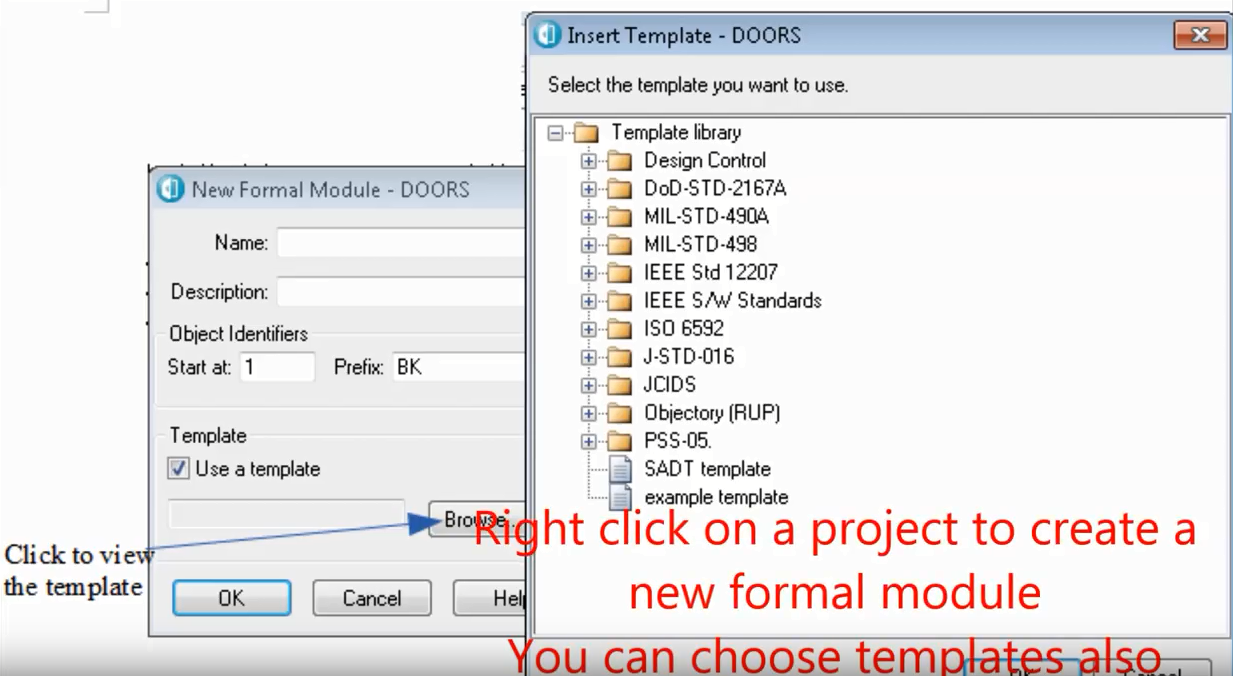
Click chuột phải vào icon project để tạo ra một formal module mới, bạn cũng có thể chọn template ở đây bằng cách click chuột trái vào browse icon.

3

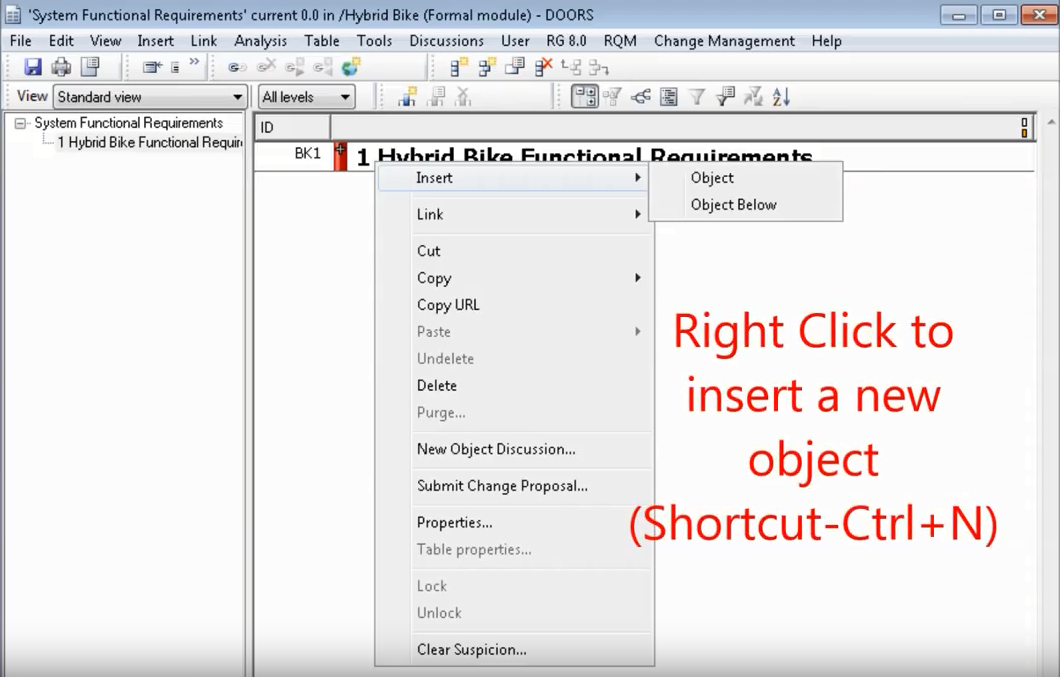
Sau khi các bạn tạo ra formal module cho riêng mình, chuột phải vào module đó để tạo ra một object mới. Các bạn cũng có thể dùng phím tắt để làm điều tương tự.

4

Hình phía dưới giải thích những vị trí của objects, gồm có level1 object, level2 objects là con của level1 object. Ở bên trái là ID của objects.

5

Click chuột phải vào level2 object sau đó click vào properties để thêm text vào object.

6

Đây là access của một object, bạn có thể chọn bằng cách bấm qua chọn access bên cạnh general.

7

Bạn cũng có thể thêm table từ table menu dưới mỗi object, khi add table bạn có thể set hàng và cột. Sau khi add table xong thì sẽ như hình sau.

9

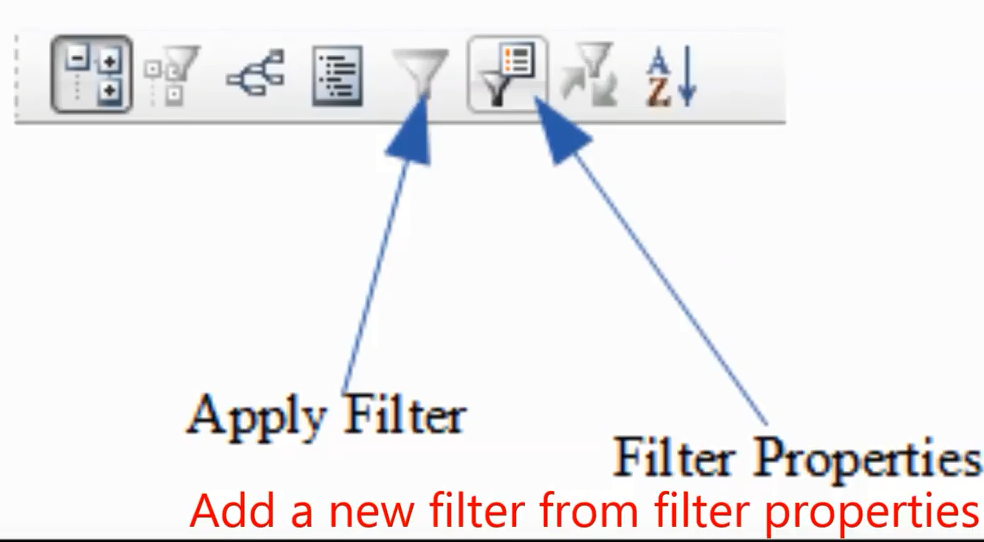
Chúng ta có thể thêm filter bằng cách click chuột vào biểu tượng filter properties.

10.PNG

Thêm một object mới bằng cách click chuột phải vào một object chọn Link, start Link. Sau đó click một cái object Link mới, chọn link from start để hoàn thành quá trình link.

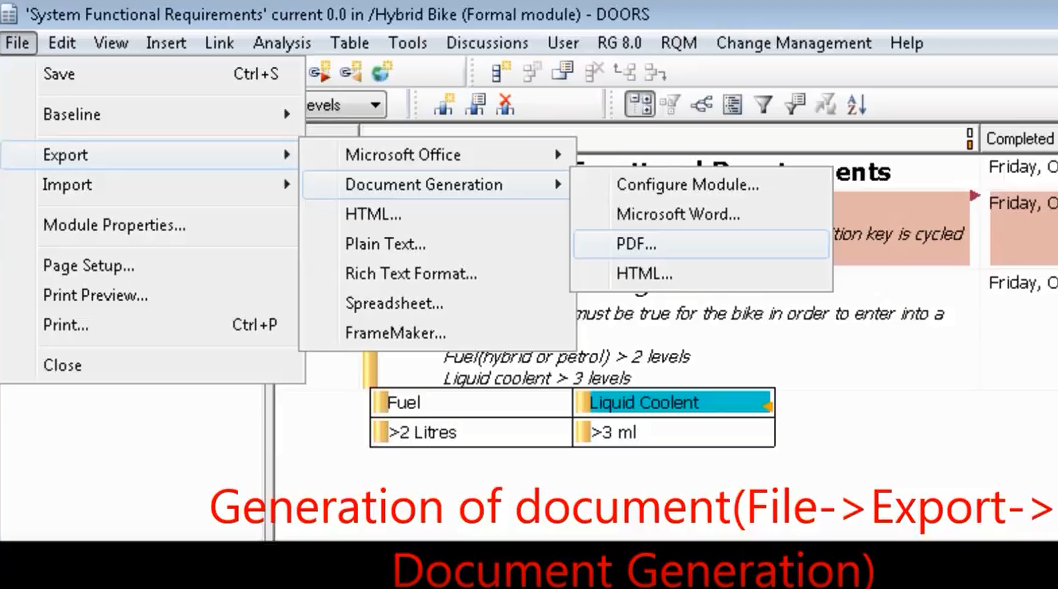
Để tạo ra một document, chọn File -> Export -> Document Generation như hình bên dưới.

11


Posted in Self-Driving Car

Occupancy-Grid Maps

Occupancy-grid maps (H.P. Moravec, 1988; H.P. Moravec et al, 1989; A. Elfes, 1987, A. Elfes, 1989; S. Thrun et al, 2005) :

Occupanny-grid map (bản đồ lưới) thể hiện môi trường được chia nhỏ thành các mắt lưới, các ô này có thể tự do( free) hoặc bị chiếm giữ( occupied), mỗi ô đại diện cho một diện tích thực tế trong môi trường thực và mỗi ô sẽ có một giá trị biểu diễn xác xuất nó có đang bị chiếm giữ hoặc tự do (chiếm giữ ở đây nghĩa là ở đó có vật cản, hoặc tường .., tự do(free) nghĩa là tại vị trí đó không có gì cả, và chúng ta có thể đi qua khu vực đó.

Giá trị occupancy của ô thứ nhất trong occupancy grid-map tại thời điểm t được biểu diễn bởi xác xuất p, .. P tại thời điểm t phải nằm trong khoảng từ 0 tới 1. Ta có thể hiểu rằng P= 1 nghĩa là ô đó bị chiếm giữ(occupied), P=0 nghĩa là ô đó trống(free), P=0.5 nghĩa là không biết(unknown) hoặc khu vực chưa khám phá (unexplored area).

Các bạn có đồng ý rằng, Robot không có bất kì nhận định nào về thế giới mà lần đầu nó bị đặt vào trong đó. Cũng như bạn bị bắt cóc đến một nơi xa lạ vậy, bạn hoàn toàn mất phương hướng. Do đó P sẽ có giá trị P=0.5 co tất cả i tại thời điểm t=0. Map sẽ được cập nhật thông qua log odds của occupancy. Sự vượt trội của log odd là nó có thể tránh được sự nhập nhằng giữa 0 và 1, vì đôi khi giá trị của nó sẽ là 0,3 hoặc 0,7. Do đó, ta có cách tính tình trạng bị chiếm giữ của ô thứ n trong grid-map theo công thức sau:

 { l }_{ t,f\quad }=\quad { l }_{ t-1,f }\quad +\quad { l }_{ sensor }

với lt-1 là log odds được tính từ giá trị occupancy của ô tại thời điểm t-1. Hình 1(a) miêu tả quá trình cập nhật của map. Ô màu đen thể hiện tia laser gặp phải vật cản ở đó ngược lại  các ô màu trắng thể hiện là những vị trí có tia laser đi qua nhưng không bị cản trở, ô màu xám là nơi tia laser không đi qua. Hình 1(b) thể hiện trường hợp tia laser không gặp vật cản nào nhưng đạt mức maximum của nó.

12

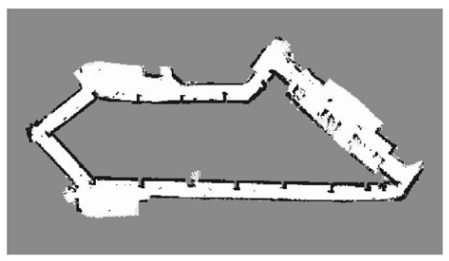
Hình ảnh dưới đây là Occupancy Grid map trong thực tế được tạo bởi một máy quét laser, khu vực rìa màu đen thể hiện vật cản, khu vực trắng là trống và khu vực màu xám là tia laser chưa đi qua.

13

Topological  Maps,

Không giống như occupancy grid map, topological maps (D. Kortenkamp et al, 1994; H. Choset, 1996; H. Choset et al, 1996) không thể hiện môi trường xung quanh một cách trực quan bằng cách chia nhỏ bản đồ ra như trên. Thay vào đó, topological map thể hiện môi trường quanh nó như một đồ thị (graph).

Giống như trong hình 3. Một danh sách những khu vực quan trọng như tường, góc, cửa hoặc hành lang, những khu vực này được thể hiện dưới dạng các điểm(node) m. Sự liên kết giữa các điểm m được thể hiện dưới các liên kết Uk. Trong rất nhiều topological map, khoảng cách giữa các khu vực cũng được thể hiện trong các sợi dây liên kết các nodes này. Sự ưu việt của topological map là nó thể hiện các khu vực trong map rất chi tiết, ta có thể zoom vào để xem đặc tính từng khu vực, điều này lý giải tại sao topological map được dùng để phát triển 3D-map.

14

Topological maps là sự lựa chọn tối ưu hơn nếu người dùng quan tâm dung lượng bộ nhớ. Trong trường hợp chúng ta sử dụng laptop hay raspberry pi có dung lượng bộ nhớ thấp. Đó là bởi vì ít memory cần để lưu giữ nodes so với một số lượng lớn các ô được sử dụng trong grid-map. Tuy nhiên điều này cũng đồng nghĩa với, graph-map sẽ ít chính xác hơn grid-map. Lý do là một số thông tin quan trọng ví dụ như vị trí của các ô màu xám mà tia laser không đến được sẽ không được hiển  thị trong bản đồ. Do đó khi robot sử dụng graph-map sẽ không thể di chuyển nhanh mà vẫn giữ an toàn như sử dụng grid-map, lời khuyên là khi sử dụng topological map thì nên cho robot di chuyển chậm thôi.


Posted in Self-Driving Car

Autonomous Navigation

Trong bài viết này mình sẽ nói về một đề tài rất thú vị, đó là “Xe tự lái “, hẳn các bạn cũng nghe về chủ đề này nhiều rồi. Đây là một hướng đi mới cho ngành công nghiệp xe hơi vốn ít có những thay đổi đột phá từ khi những chiếc xe bốn bánh lần đầu tiên lăn bánh trên đường vào đầu thế kỉ 19, đến nay đã gần 200 năm trôi qua và chúng vẫn là … xe bốn bánh:)).

Mặc dù có rất nhiều nâng cấp về tốc độ, mẫu mã, nhiên liệu sử dụng, nhưng khi nói về auto quan niệm của chúng ta vẫn là một cỗ máy 4 bánh được mấy bác tài xế lái đưa chúng ta đi mọi miền tổ quốc. Vâng, người lái ở  đây chính là điểm mấu chốt, chứ không có ai lái thì xe xịn mấy cũng đắp chiếu!

Vào năm 2004 đã có 1 cuộc thi về những chiếc xe có thể tự vận hành mà không cần người điểu khiển đã được tổ chức tại Mỹ, từ đây đã tạo ra một cuộc chạy đua giữa các công ty ô tô, để sản xuất chiếc xe tự lái cho riêng mình. Hẳn các bạn thắc mắc là tại sao từ năm 2004 đến nay đã là 2018, nhưng vẫn chưa thấy xe tự lái xuất hiện. Thực ra là nó đã xuất hiện và đang được các công ty chạy thử nghiệm rồi, chỉ là đang hoàn thiện nên bản thương mại hóa chưa được bán.

OK, mình nghĩ nói về lịch sử như vậy là đủ, bây giờ mình sẽ nói về cách thức hoạt động của một chiếc xe tự lái:

Capture9

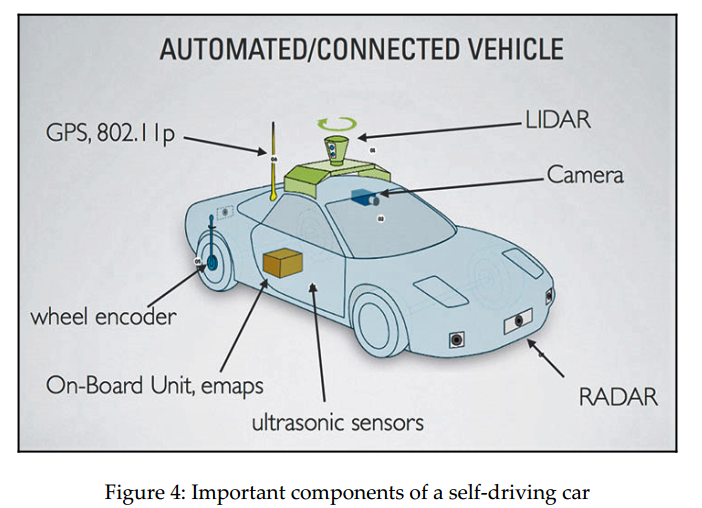
Hình trên mô tả các bộ phận của một chiếc xe tự lái, bao gồm:

  • LIDAR, máy quét laser dùng để quét môi trường xung quanh và tạo ra một bản đồ khu vực(local map) xung quanh xe.
  • Camera, được gắn trước mũi xe để tính toán xem xe có chạy đúng làn hay không, nó cũng được tích hợp một số thuật toán xử lý ảnh kết hợp với machine learning để phân biệt được những biển báo giao thông và các phương tiện giao thông khác.
  • Một Radar được gắn trước mũi xe, để xác định khoảng cách tới xe phía trước, từ đó đưa ra vận tốc chạy xe hợp lý.
  • Ultrasonic sensor được gắn ở cửa bên hông xe, để tính khoảng cách với lề đường hoặc các xe chạy bên cạnh.
  • On-board unit chính là bộ xử lý chính của xe tự lái, thường sẽ là một bộ vi xử lý mạnh như là Intel Xenon và GPU để tổng hợp dữ liệu từ các cảm biến nói trên. E-map chính là bản đồ khu vực được máy chủ của xe kết hợp với GPS để biết chính xác vị trí của xe.
  • Wheel encoder, chính là cái bánh, nói đúng hơn thì là bộ phận trực tiếp điều khiển bánh xe, nó sẽ nhận lệnh từ on-board unit như là rẽ phải, quẹo trái, đi thẳng.., và điều khiển bánh xe theo những lệnh này.

Như các bạn đã biết, GPS là dùng để định vị chúng ta trên thế giới này với sự giúp đỡ của vệ tinh, và chúng ta cũng biết là nó không chính xác lắm, tầm 99% thôi. GPS được dùng để xác định Kinh độ và Vĩ độ của chiếc xe. Sự chính xác của GPS được cải thiện bởi các loại cảm biến được gắn trên xe, một số cảm biến có độ chính xác được tính bằng m, một số chính xác nhỏ hơn 1 mét.  Bng cách kết hợp GPS, IMU (Inertial measurement units) và wheel odometry data, bằng thuật toán sensor fusion, vịtrí của xe được xác định một cách chính xác hơn.

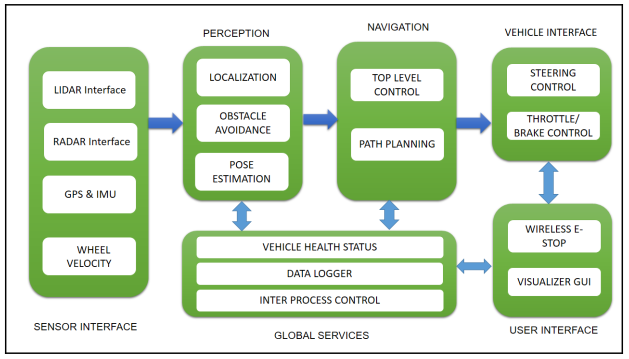
Dưới đây là block diagram (sơ đồ hoạt động) của một chiếc xe tự lái được sử dụng trong DARPA Challenge:

xxx

Sensor interface modules: Bao gồm tất cả tương tác giữa các cảm biến và chiếc xe ,những cảm biến chính của xe bao gồm LIDAR, Radar, camera, IMU, GPS và wheel encoders.

Perception modules: Đây là nơi tiếp nhận và xử lý tín hiệu từ tất cả các cảm biến như LIDAR, camera… để định vị những vật thể tĩnh hoặc động ở môi trường xung quanh xe và tạo ra một bản đồ cục bộ, đồng thời cũng giúp xác định vị trí của chính chiếc xe dựa trên vị trí của các vật trong bản đồ cục bộ nói trên.

Navigation modules: Xác định hành vi của chiếc xe tự lái, bao gồm tính toán quãng đường đi chính xác nhất cho xe cũng như điều khiển các module khác như là thắng khẩn cấp hoặc gạt nước tự động.

Vehicle interface: Sau khi tính toán được quãng đường ngắn nhất, các lệnh điều khiển, bao gồm điều khiển vô-lăng, bánh xe, thắng, sẽ được gửi từ bộ vi xử lý tới chiếc xe thông qua Drive-By-Wire(DBW) interface. DBW về cơ bản được xây dựng giống như CAN Bus system.

User interface: Đây là nơi chúng ta có thể thấy và tương tác được với hệ thống xe tự lái, bao gồm màn hình touch screen để chúng ta có thể nhập điểm đến, hoặc có thể điều khiển bằng giọng nói. Tất nhiên cũng có nút bấm để ngắt toàn bộ hệ thống trong trường hợp nguy hiểm.

Posted in Robotics

RTAB-Map and Kidnapped Robot

One of the more difficult challenges in robotics is the so-called “kidnapped robot problem.”  Imagine you are blindfolded and taken by car to the home of one of your friends but you don’t know which one.  When the blindfold is removed, your challenge is to recognize where you are.  Chances are you’ll be able to determine your location, although you might have to look around a bit to get your bearings.  How is it that you are able to recognize a familiar place so easily?

It’s not hard to imagine that your brain uses visual cues to recognize your surroundings.  For example, you might recognize a particular painting on the wall, the sofa in front of the TV, or simply the color of the walls.  What’s more, assuming you have some familiarity with the location, a few glances would generally be enough to conjure up a “mental map” of the entire house.  You would then know how to get from one room to another or where the bathrooms are located.

Over the past few years, Mathieu Labbé from the University of Sherbrooke in Québec has created a remarkable set of algorithms for automated place learning and SLAM (Simultaneous Localization and Mapping) that depend on visual cues similar to what might be used by humans and other animals.  He also employs a memory management scheme inspired by concepts from the field of Psychology called short term and long term memory.  His project is called RTAB-Map for “Real Time Appearance Based Mapping” and the results are very impressive.

Real Time Appearance Based Mapping (RTAB-Map)

The picture on the left is the color image seen through the camera.  In this case, Pi is using an Asus Xtion Pro depth camera set at a fairly low resolution of 320×240 pixels.  On the right is the same image where the key visual features are highlighted with overlapping yellow discs. The visual features used by RTAB-Map can be computed using a number of popular techniques from computer vision including SIFT, SURF, BRIEF, FAST, BRISK, ORB or FREAK.  Most of these algorithms look for large changes in intensity in different directions around a point in the image.  Notice therefore that there are no yellow discs centered on the homogeneous parts of the image such as the walls, ceiling or floor.  Instead, the discs overlap areas where there are abrupt changes in intensity such as the corners of the picture on the far wall.  Corner-like features tend to be stable properties of a given location and can be easily detected even under different lighting conditions or when the robot’s view is from a different angle or distance from an object.

RTAB-Map records these collections of visual features in memory as the robot roams about the area.  At the same time, a machine learning technique known as the “bag of words model” looks for patterns in the features that can then be used to classify the various images as belonging to one location or another.  For example, there may be a hundred different video frames like the one shown above but from slightly different viewpoints that all contain visual features similar enough to assign to the same location.  The following image shows two such frames side by side:

rtabmap-image-match

Here we see two different views from essentially the same location.  The pink discs indicate visual features that both images have in common and, as we would expect from these two views, there are quite a few shared features.  Based on the number of shared features and their geometric relations to one another, we can determine if the two views should be assigned to the same location or not.  In this way, only a subset of the visual features needs to be stored in long term memory while still being able to recognize a location from many different viewpoints.  As a result, RTAB-Map can map out large areas such as an entire building or an outdoor campus without requiring an excessive amount of memory storage or processing power to create or use the map.

Note that even though RTAB-Map uses visual features to recognize a location, it is not storing representations of human-defined categories such as “painting”, “TV”, “sofa”, etc.  The features we are discussing here are more like the receptive field responses found in lower levels of the visual cortex in the brain.  Nonetheless, when enough of these features have been recorded from a particular view in the past, they can be matched with similar features in a slightly different view as shown above.

RTAB-Map can stitch together a 3-dimensional representation of the robot’s surroundings using these collections of visual features and their geometric relations.  The Youtube video below shows the resulting “mental map” of a few rooms in a house:

The next video demonstrates a live RTAB-Map session where Pi Robot has to localize himself after been set down in a random location.  Prior to making the video, Pi Robot was driven around a few rooms in a house while RTAB-Map created a 3D map based on the visual features detected.  Pi was then turned off (sorry dude!), moved to a random location within one of the rooms, then turned on again.  Initially, Pi does not know where he is.  So he drives around for a short distance gathering visual cues until, suddenly, the whole layout comes back to him and the full floor plan lights up.  At that point we can set navigation goals for Pi and he autonomously makes his way from one goal to another while avoiding obstacles.

Posted in Home

Du lịch Bắc Âu

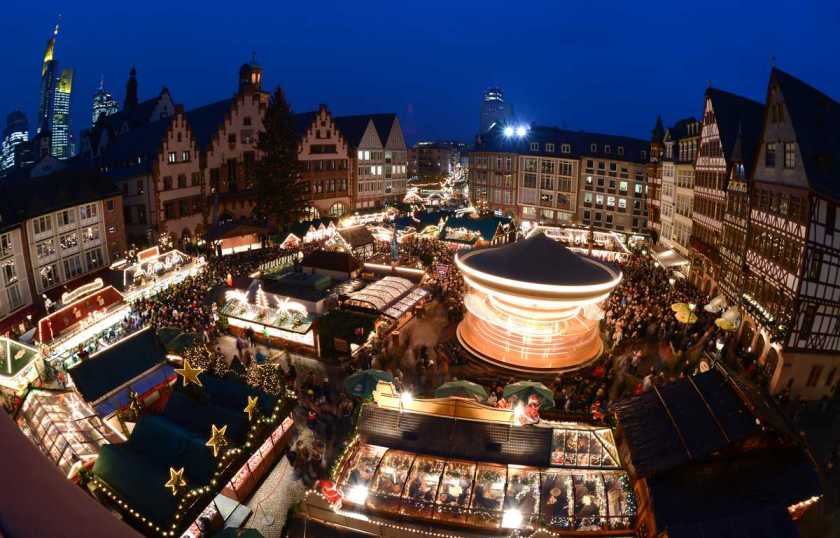
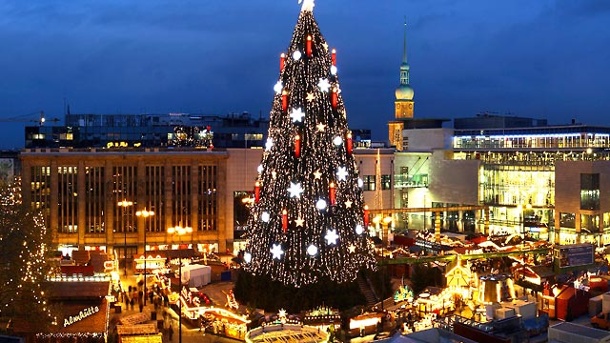
Hallo các bạn, hôm nay mình xin kể về chuyến đi 3 nước khu vực bắc âu mà mình vừa mới đi tháng 12 năm nay.

Chả là trước giờ mình nghe trên phía bắc, khu vực băng tuyết dày đặc có 1 sư kiện tuyệt đẹp xảy ra gọi là cực quang( polar light), dành cho bạn nào chưa biết thì nó như này này

6860114-polar-lights-wallpaper.jpg

Đấy, đẹp chưa!!

Ấy vậy mà sự thật thì chẳng được vậy đâu, à mà thôi, để kể từ đầu chứ mới vô đã dìm thế này ai còn muốn đi nữa:)))

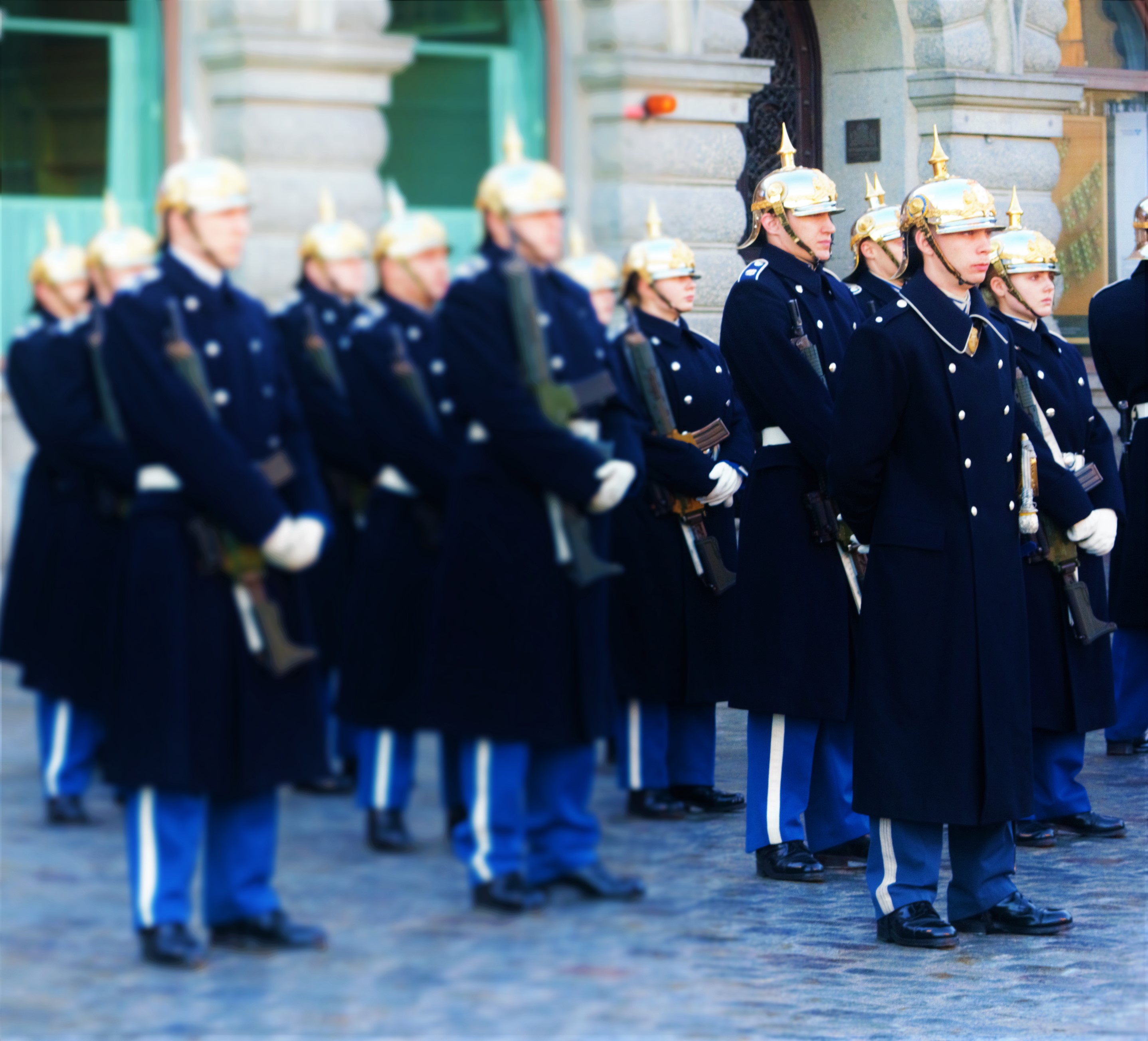
Chuyến đi kéo dài trong vòng 4 ngày với lịch trình như sau. Ngày đầu tiên đi máy bay đến Sweeden, ăn chơi nhảy múa ở đó đến chiều thì lên cruise( cái tàu to to sang sang chảnh chảnh chuyên chở khách du lịch trên phim ấy), từ Copehagen sang Helsinki, thủ đô Findland. Từ FindLand sẽ đi bus Lên cái làng mà hồi xưa có ông già rảnh hay vác của nhà đi cho sau này người ta gọi là ông già noen hay Santa Claus gì ấy. Cuối cùng đi tàu sang Talin thủ đô của Estonia, rồi đi về thôi. Giờ câu chuyện sẽ bắt đầu ở Copehagen. Ở đây hơi bị… buồn, thật áy náy với mấy bạn thuỵ Điển cơ mà thủ đô của mấy bạn toàn người già, hông thấy nhộn nhịp gì hết trơn. Cơ  mà nhà đẹp, đồ ăn ngon với cả đặc sản cung điện hoàng gia với mấy anh lính đứng canh anh nào cũng rất là…. Kiên nhẫn, muỗi đốt không dám đập, mưa ướt không dám lau, ngứa… Không dám gãi. Phải rồi, trang bị tận răng cơ với cả chắc lương cao ngất ngưởng chỉ mỗi việc đứng đấy từ sáng tới chiều cho thiên hạ người ta chụp hình, bình luận, dò xét:)). Dưới đây là hình cực ngẩu của mấy ảnh (máy cùi chụp bị mờ, các bạn thông cảm, hì hì).

DSC_0046

Posted in Home

The Witcher 3: Wild Hunt

The Witcher 3: Wild Hunt (Polish: Wiedźmin 3: Dziki Gon) is a high-fantasy, action role-playing video game set in an open-world environment, developed by CD Projekt RED. Announced in February 2013, it was released worldwide for Microsoft Windows, PlayStation 4, and Xbox One on 19 May 2015. The game is the third in the series, preceded by The Witcher and The Witcher 2: Assassins of Kings, which are based on the series of fantasy novels by Polish author Andrzej Sapkowski.

Played in a third-person perspective, players control protagonist Geralt of Rivia, a monster hunter known as a witcher, who sets out on a long journey through the Northern Kingdoms. In the game, players battle against the world’s many dangers using swords and magic, while interacting with non-player characters and completing side quests and main missions to progress through the story. The game was met with critical acclaim and was a financial success, selling over 6 million copies in six weeks. The game won over 200 Game of the Year awards from various gaming websites, critics, and game award shows including the Golden Joystick Awards and The Game Awards.

The purpose of this guide is to maximize your chances for romantic encounters in The Witcher 3: Wild Hunt. Some of the characters Geralt gets to bed are true romantic interests, while others are just casual partners. Either way, in order to end up in bed with your chosen partner, you’ll have to seduce them. This will be done through gifts, sweet talking and similar actions. In this Witcher 3 romance guide, we’re going to list all the character we find you can have sex with, as well as the conditions for having it.

While adventuring, Geralt of Rivia has more than one opportunity to polish more than his steel sword for an evening. There are a number of women that can be wooed into a night of passion. But how many? Who? And where? Glad you asked. The following are the times, quests (where appropriate), and ladies you can spend a romantic evening, or a rutting session, with. Any stipulations are listed in their appropriate quests.

wicher

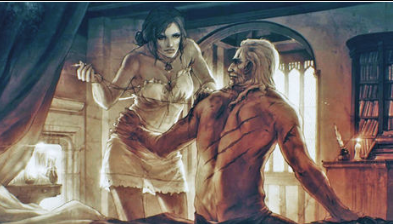
Those who’ve played the previous games are already familiar with Triss – she has starred in both of the former games, and has been available for romance in both, too. Once again, she can be a romantic interest if you choose so. You need to finish her sidequest – Now or Never, after you’ve done the main quest A Favor For Radovid, as well as the secondary quest A Matter of Life And Death.

During the A Matter of Life and Death, you need to kiss Triss at the masquerade. When you start Now or Never, go and defend the mages. When you’re at the docks near the end, Triss is resolved to leave for Kovir with the other sorcerers. Geralt can ask her to stay, telling her that they can try to make their relationship work, or he can truly pour his heart out and tell her that he loves her. She then boards the boat, but (if Geralt said he loves her and only then) comes back for you. You then have sex at a lighthouse.

Posted in Home

Đông Sơn drums

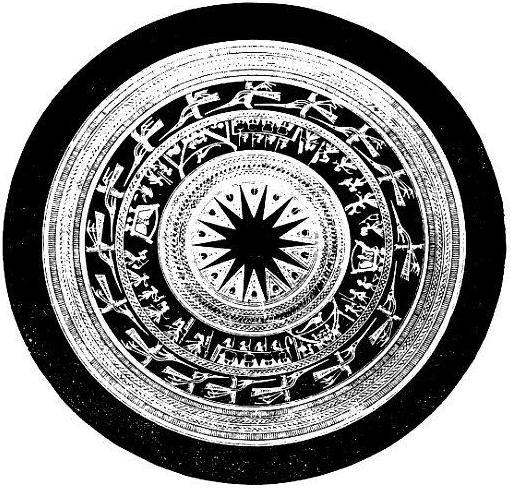
Đông Sơn drums (also called Heger Type I drums) are bronze drums fabricated by the  Đông Sơn culture in the Red River Data of northern Vietnam. The drums were produced from about 600 BCE or earlier until the third century CE and are one of the culture’s finest examples of Metalworking.

The drums, cast in bronze using the lost-wax casting method are up to a meter in height and weigh up to 100 kilograms (220 lb). Đông Sơn drums were apparently both musical instrument and cult objects. They are decorated with geometric patterns, scenes of daily life and war, animals and birds, and boats. The latter alludes to the importance of trade to the culture in which they were made, and the drums themselves became objects of trade and heirlooms. More than 200 have been found, across an area from eastern Indonesia to Vietnam and parts of Southern China.

History

Co_Loa_bronze_drum

The earliest drum found in 1976 existed 2700 years ago in Wangjiaba in Yunnan Chuxiong Yi Autonomous Prefecture China. It is classified into the bigger and heavier Yue drums including the Dong Son drums, and the Dian drums, into 8 subtypes, purported to be invented by Ma Yuan and Zhuge Liang. But the Book of the Later Han said Ma melt the bronze drums seized from the rebel Lạc Việt in into horse.

The discovery of Đông Sơn drums in New Guinea, is seen as proof of trade connections – spanning at least the past thousand years – between this region and the technologically advanced societies of Java and China.

In 1902, a collection of 165 large bronze drums was published by F. Heger, who subdivided them into a classification of four types.

For generations, the Dong Son bronze drum, typical of the Dong Son culture and the Red River civilization of the ancient Viet people in the Hung Vuong period, built the Van Lang country to become a sacred symbol of Vietnamese national culture. . The image of the bronze drum is not only a precious treasure of Vietnamese culture, but also a convergence of the sacred mountains and rivers formed from the time of Hung Vuong’s creation and accumulating national essence throughout the history of construction. country and national defense of Vietnam from the era of Hung Kings to the era of glory Ho Chi Minh. Dong Son bronze drums discovered throughout the territory of Vietnam proved that. During thousands of years of building the country and defending the country, the bronze drum has been a symbol of cultural quintessence as well as the mighty will of our nation. In solemn ceremonies as well as joyful summer festivals, the resounding sound of the drums resounding in the bronze drum creates a majestic atmosphere, increases national pride and makes the Nguyen Dynasty’s ambassador Tran Phu upon setting foot. Arriving at Thang Long land, heard the drum sound: “Kim through the image of the heart of the heart; The ancient bronze is pure white arises” (Afraid to see the sword shine; Gray hair because of hearing the drum sound) The homeland of the Dong Son bronze drum is the Ancestral Land in the midland of Phu Tho and the provinces of North and North Central Vietnam. Dong Son bronze drums existed from the 7th century BC to the 6th century AD. It is a brainchild of the ancient Vietnamese. Our ancestors overcame the harshness of nature with rare courage, intelligence and creativity, created a brass metallurgical technique imbued with Vietnamese indigenous elements, and created a copper culture. brass is among the first in Southeast Asia. Dong Son bronze drums are the product of an agricultural civilization that grows brilliantly and shines bright on the basin of the Red River – Cai River of Viet Nam’s Motherland – The birthplace of the nation and land. Vietnam country today.

Source: Internet

Vietnamese bronze drums have many types, but all of them originate from Dong Son drums, which are the I Hê-Gơ drums according to the classification of German archaeologists. The drum was born from the Dong Son culture associated with the period of Hung Kings building up Van Lang country, where Phu Tho was the center of Dong Son culture – Red River civilization – The pinnacle of technical perfection. The largest ever drum size of Hung Temple was discovered in 1990 at Doi Moi Muoi – an old village near the foot of Nghia Linh mountain – where the Hung Kings Temple was built. country. That proves: The bronze drum of Hung Temple is a sacred object used by the State of Van Lang as a mascot every festival and summer festival at Hung Temple historic site. Along with many other type I bronze drums found on the land of Vietnam, these are extremely valuable documents proving the birth origin and a sacred place in the Vietnamese spiritual life. The bronze drum is not only the mascot, but through which we have been clarified many scientific issues, but the drum is the message that forms the most centralized symbol of achievements in economic, cultural, social and social activities. the authority of a state was first established in our country – Hung Vuong State. The bronze drums and the carvings on the drums help us today to imagine a few features of the life of the ancient Vietnamese in that ancient time. Patterns on bronze drums have many types, reasonably arranged on the face, tang and body. It is researched and analyzed by researchers to serve as a scientific basis in classifying the drum and depicting features of Dong Son economic, social and cultural activities at that time. The bronze drum not only has the function of musical instrument, but also has other functions such as a symbol of power, religion … The drum is used in religious ceremonies, festivals, and in the fight against foreign invaders. invasion, when the tribal leader calls on people from all over to gather to fight. Drums often belong to leaders and are symbols of power. The more powerful the leader, the bigger and beautiful the drum is. The bronze drum is also considered a valuable asset, and is made a funeral when the owner dies. Dong Son bronze drum is a product of a developed agricultural civilization, an extremely precious artifact, one of the deep pride of Vietnamese culture. Today, hundreds of bronze drums are discovered and stored solemnly in national and local museums, Thanh Son in the west of Phu Tho province is the only place in Vietnam that still remains. Bronze drum festival of the Muong ethnic group with festivals “Dam Duong” and “Cham brass”. This is also one of the sacred areas of Phu Tho province that has found the most bronze drums in the ground. It is for that reason that Phu Tho province has restored a sacred rite of beating bronze drums on the anniversary of Hung Vuong’s death anniversary – Hung Temple Festival on March 10th of lunar calendar every year to serve local people and tourists. to attend the festival’s activities. This is an activity to show respect and honor cultural values, through which, actively promote activities to preserve and promote the values ​​of cultural heritages in general and heritage emblems. typical traditional culture of the Vietnamese nation in particular. Contribute to strengthening the cohesion and solidarity of the Vietnamese community in order to arouse the traditional pride in the struggle to build and defend the country of the Vietnamese people, practically contribute to the moral education of “Drink water, remember its source” ; “Miss the tree grower” for generations to follow the glorious tradition of his father. Following the admonition of the beloved Uncle Ho when he visited Hung Temple and the Hung Kings: “… The Hung Kings have made a contribution to the country, our Uncle and I must keep together …”. Together, solidarity, joint strength, and our heart and soul to build a strong and prosperous Vietnam to step on the path of socialism for the following goals: Rich people, strong country, fairness, democracy and civilization stand shoulder to shoulder with the above powers. world. From Hung Temple, the sound of Dong Son bronze drums will be echoed and echoed to all parts of the country. From Hung Temple, the sound of Dong Son bronze drums will be echoed in the hearts of international friends across the five continents and four seas. From Hung Temple, the sound of bronze drums echoes as affirming the values ​​of tradition, deep human morality of the Vietnamese people throughout the history of building and defending the country with many events and ups and downs. stand firm and proudly grow with humanity.

Posted in Robotics

RobotCup: The Future Champion League

RoboCup is an annual international robotic competition proposed in 1997 and founded in 1997. The aim is to promote robotics and AI research, by offering a publicly appealing, but formidable challenge. The name RoboCup is a contraction of the competition’s full name, “Robot Soccer World Cup”, but there are many other stages of the competition such as “RoboCupRescue”, “RoboCup@Home” and “RoboCupJunior”. In 2015 the world’s competition was held in Heifei, China. RoboCup 2016 will be held in Leipzig, Germany. The official goal of the project:

“By the middle of the 21st century, a team of fully autonomous humanoid robot soccer players shall win a soccer game, complying with the official rules of FIFA, against the winner of the most recent World Cup”.

As a Master student of Frankfurt University, I aslo have a project with the Robot who is the best choice for for the Robot Cup as the moment, his name is NAO.

NAO

Nao (pronounced now) is an autonomous, programmable humanoid robot developed by Aldebaran Robotics, a French robotics company headquartered in Paris. The robot’s development began with the launch of Project Nao in 2004. On 15 August 2007, Nao replaced Sony’s robot dog Aibo as the robot used in the Robot Cup Standard Platform League, an international robot soccer competition. The Nao was used in RoboCup 2008 and 2009, and the NaoV3R was chosen as the platform for the SPL at RoboCup 2010. Nao robots have been used for research and education purposes in numerous academic institutions worldwide. As of 2015, over 5,000 Nao units are in use in more than 50 countries.